Covid-19 CXR Analyzer
Model Revision Record
Deployment Status: Prototype
Revision: Rev-P0
Date: 14-July-2021
Revised by: vbookshelf
Details: Released for demonstration.
Known Issues:
1- Both the app frontend and the api server have not been secured with an SSL certficate. This will need to be addressed if this app were to move beyond the demo stage.
Purpose
This web app uses computer vision to automatically detect covid-19 on chest x-rays. It classifies each image into one of two classes: Negative for pneumonia and Typical.
This is a prototype that has not been field tested. Please use it for educational and demonstration purposes only.
Input
1- Submitted images should be in jpg or png format.
2- The dicom and tiff formats are not supported.
Output
The app outputs one of two predicted classes - Negative for pneumonia or Typical. When the app predicts 'Typical', it draws a bounding box around the area where opacity was detected.
According to the competition website, this is what the labels mean:
- Negative for Pneumonia: No lung opacities.
- Typical Appearance: Multifocal bilateral, peripheral opacities with rounded morphology, lower lung–predominant distribution.
Dataset Summary
The Yolov5 model that powers this app was fine tuned using data from the Kaggle SIIM-FISABIO-RSNA COVID-19 Detection competition.
The original dataset has four classes: negative for pneumonia, typical, atypical and indeterminate.
Source image format: Dicom
Training image format: jpeg
Total images: 6334
Num patients: 3261
Num female patients: 1624
Num male patients: 1637
Num female images: 2770
Num male images: 3564
Min patient age: No info
Max patient age: No info
Patient ethnicity: No info
The dataset license info can be found here.
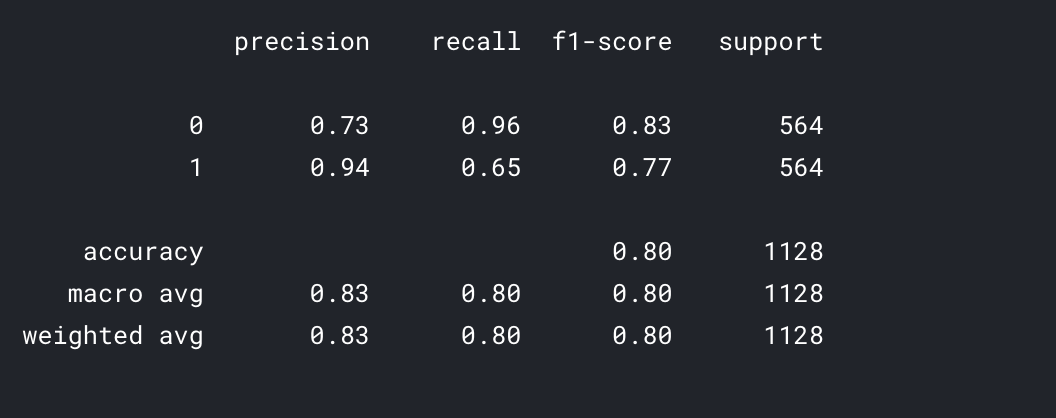
Validation Performance
Classification Report
Misc Info
1- The dataset did not include patient ages, but looking at the images it appears that there are no chest x-rays of children. Therefore, this model should not be trusted to provide accurate results on child x-ray images.
2- The model was trained on jpg images that were created from dicom source images. In practice, users may not use the same dicom to jpg conversion process or they may submit photos of raw x-ray films that were taken with various cameras under various lighting conditions. These and other real-world factors could impact the performance of the model in unknown ways.
3- The app has been optimized for use on mobile devices.
4- This demo will be live until 31 August 2021. The code, however, will be available on Github. You are welcome to use it to host this app on your own server.
Documentation
The process used to train and test the model will be published on Kaggle after the competition ends.
The frontend and backend code will be released on GitHub.
Contact
Email: contact -at- woza -dot- work
Ref: Covid-19 CXR Analyzer